
Agentic Flywheels: When AI Products Start Running (and Growing) Themselves
How self-improving AI systems are quietly building the next generation of autonomous businesses.


Ever wonder why most “AI automation” still requires you to babysit every step?
You set up workflows. You configure prompts. You monitor outputs. You adjust parameters. It’s automation that needs constant human supervision. Which defeats the entire point.
Most people assume this is how AI works: powerful assistants that need human direction. They get stuck optimizing prompts and fine-tuning settings instead of building systems that learn on their own.
But that’s backwards.
The builders moving fastest aren’t building better AI tools. They’re building AI systems that improve themselves. Systems that act, learn, and optimize without waiting for human input. They’re called agentic flywheels, and they’re quietly rewriting what AI products can do.
I’ve been tracking this shift while building my own AI systems. Every product I’ve shipped started as assisted processes. The learning curve wasn’t technical. It was philosophical:
When do you stop manually optimizing and let the system learn from its own actions?
That’s where
comes in. Alex writes The Strategy Stack, where he breaks down enterprise AI strategy with zero fluff.
What I love about Alex’s approach is how he frames autonomy: start small with one self-correcting process instead of chasing full automation from day one. It’s the same mindset I’ve used building products. Observation first, autonomy second, learning velocity as your competitive edge.
Here’s how Alex breakdown the agentic flywheel:
1. From Static Tools to Self-Improving Systems
Most AI tools today act as capable assistants — fast, precise, and highly responsive, yet still dependent on human direction. A new generation is emerging: systems that evolve on their own, improving, adapting, and creating value without constant supervision.
These systems are called agentic flywheels — AI loops that improve and scale through continuous feedback and action.
Pro Tip
Start small: Instead of building a “fully autonomous” product, identify one process (e.g., campaign optimization, pricing, or lead qualification) that can self-correct from its data.
Best Practice
Design for observation first, autonomy second. Let your system learn quietly before it starts acting independently.
Example A – The Startup
When I began advising Example A, we picked one loop: ad-creative optimization.
Step 1: We connected their Meta Ads API to a simple dashboard tracking click-through rates.
Step 2: The model observed performance but couldn’t edit anything yet.
Step 3: After two weeks of data, we fine-tuned a small GPT-4 model on the top-performing headlines.
Step 4: Only then did we let it propose new copy variants for A/B tests.
By week six, the system was self-generating and launching ad tests through Zapier with human approval. Observation built credibility — autonomy earned itself.
Example B – The Corporate
Example B’s transformation started in pricing.
Step 1: We extracted three years of transaction data into a Snowflake sandbox.
Step 2: An internal LLM monitored analysts’ manual price changes and outcomes.
Step 3: For one quarter, it produced recommendations only via a Tableau dashboard.
Step 4: After the model’s forecasts beat human accuracy by 12%, we created an “autonomy pilot”: it could adjust discounts ±2% without approval.
That bounded scope made executives comfortable — autonomy by design, not decree.
2. What Exactly Is an Agentic Flywheel?
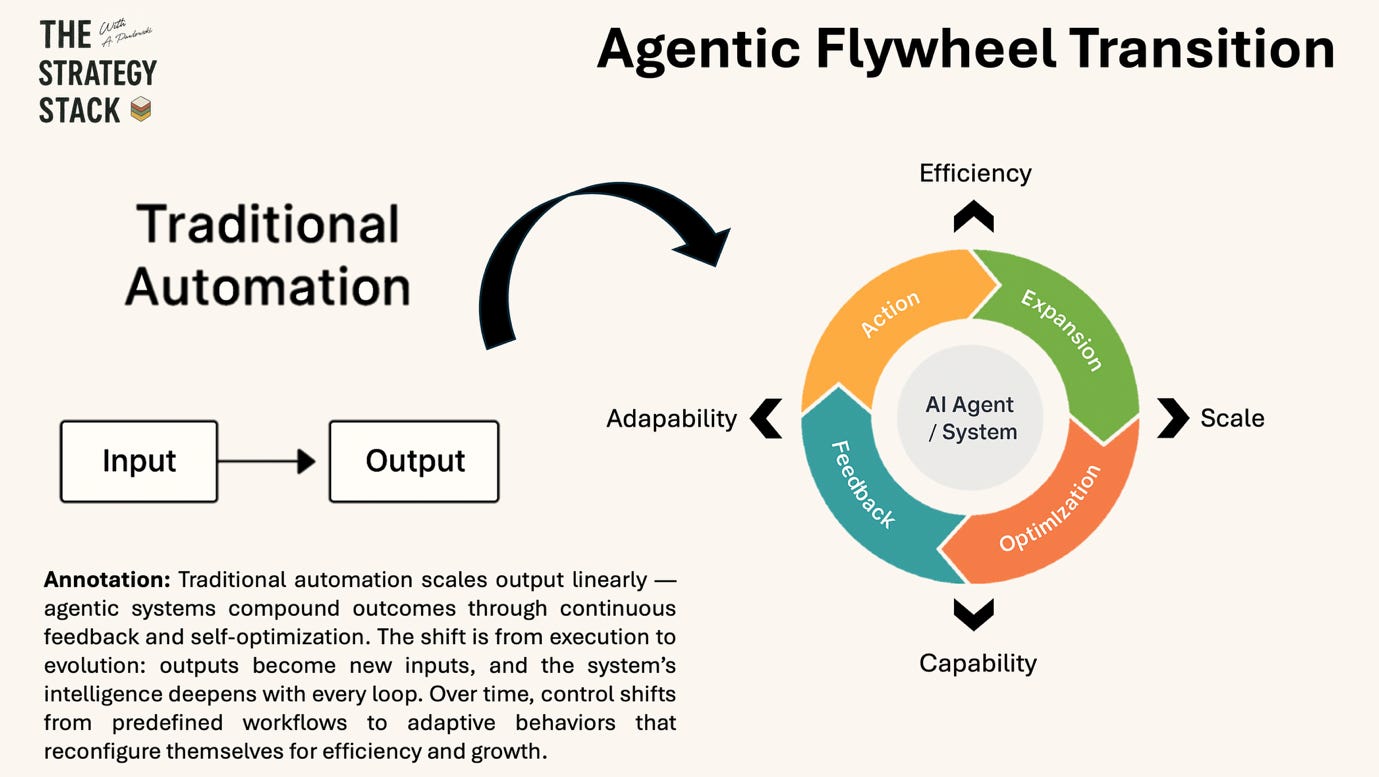
An agentic flywheel is an autonomous feedback loop — a system that acts, learns from the results, and then reinvests the learnings to act better next time.
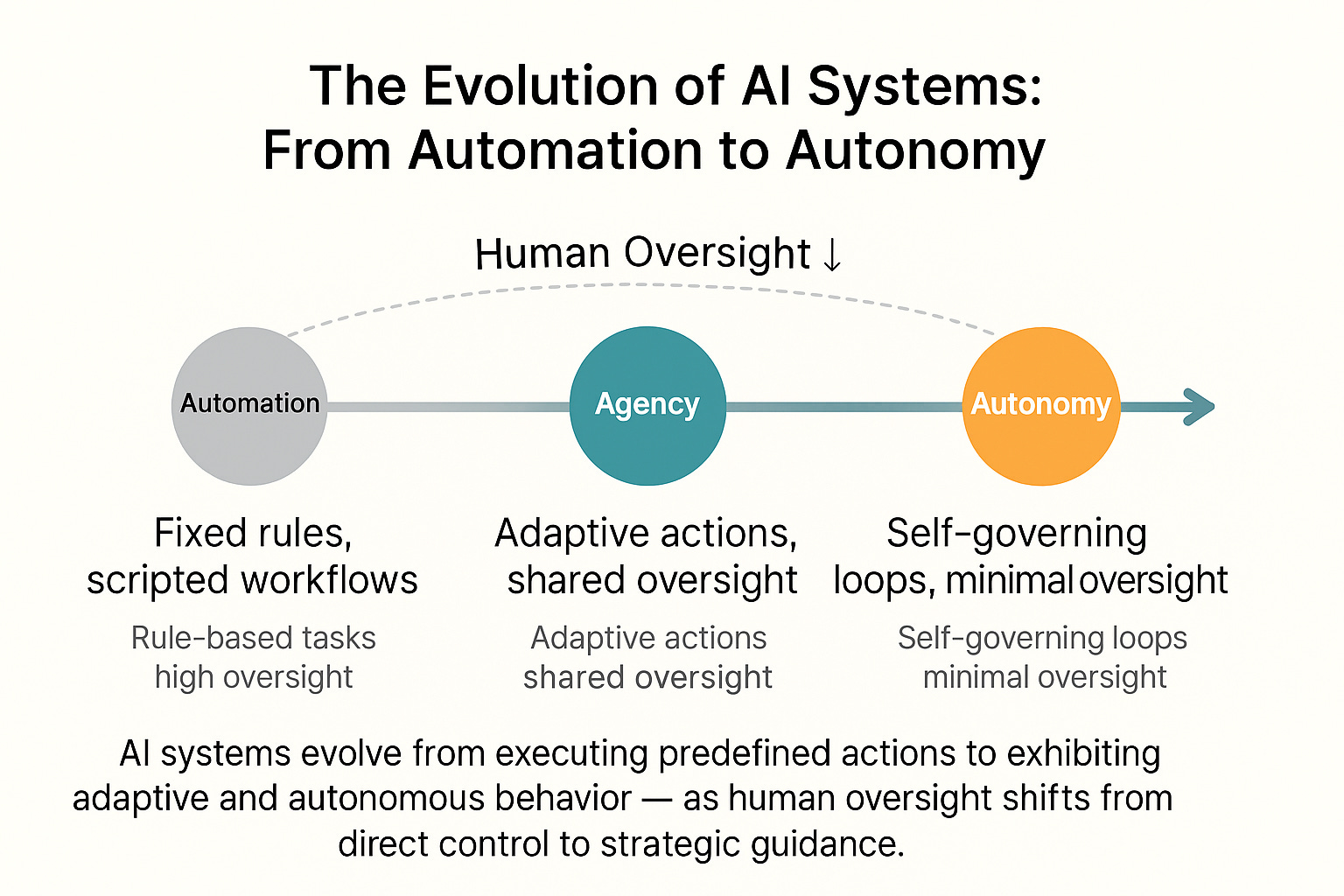
Automation → “Do the thing faster.”
Agency → “Decide how to do the thing better.”
Flywheel → “Do, learn, optimize, repeat — and grow.”
Pro Tip
Map your system’s “learning loop.” Draw each stage where it receives input, feedback, and output. If any link depends on manual correction, that’s your next automation candidate.
Best Practice
Introduce guardrails early — define ethical, financial, and operational limits for your agentic components.
Example A – The Startup
We drew the loop in Miro:
1️⃣ Input = ad metrics → 2️⃣ Model = GPT prompt → 3️⃣ Output = new copy → 4️⃣ Feedback = CTR.
Each Friday, the team ran a “loop review” in Notion — any manual fix became next week’s automation. The first guardrail we set was a budget cap enforced through the Meta API; the second was a brand-tone regex filter.
Example B – The Corporate
We mirrored that loop inside corporate structure:
1️⃣ Data warehouse feeds → 2️⃣ LLM forecaster → 3️⃣ Pricing portal → 4️⃣ Sales outcomes → back to training.
Compliance required that every recommendation carry a confidence score and reason code. Those two fields became the corporate guardrails — non-negotiable for audit trails.
3. Real-World Examples
a. Self-Optimizing Ad Engines (Meta Advantage+ and Google Performance Max)
Automates audience selection, creative testing, and budget allocation.
Learns from conversions in real time.
Often outperforms human-managed campaigns.
“Performance Max doesn’t just run your ads — it learns what works and doubles down automatically.” — Meta Product Blog, 2024.
b. AI Coding Agents (Devin, AutoGPT)
Given a high-level task (“Build a dashboard”), they plan, code, test, and iterate.
Each iteration feeds back into better task execution.
Devin by Cognition AI demonstrates early signs of “self-improvement via trial.”
c. Adaptive Media Systems
Some newsletters and blogs now use GPT-based analytics to adapt writing tone, timing, and SEO.
They use engagement data to guide what the next post covers or how it’s structured — a lightweight agentic loop.
Pro Tip
Don’t chase full autonomy too early. Use human-in-the-loop learning to prevent model drift or brand tone inconsistency.
Best Practice
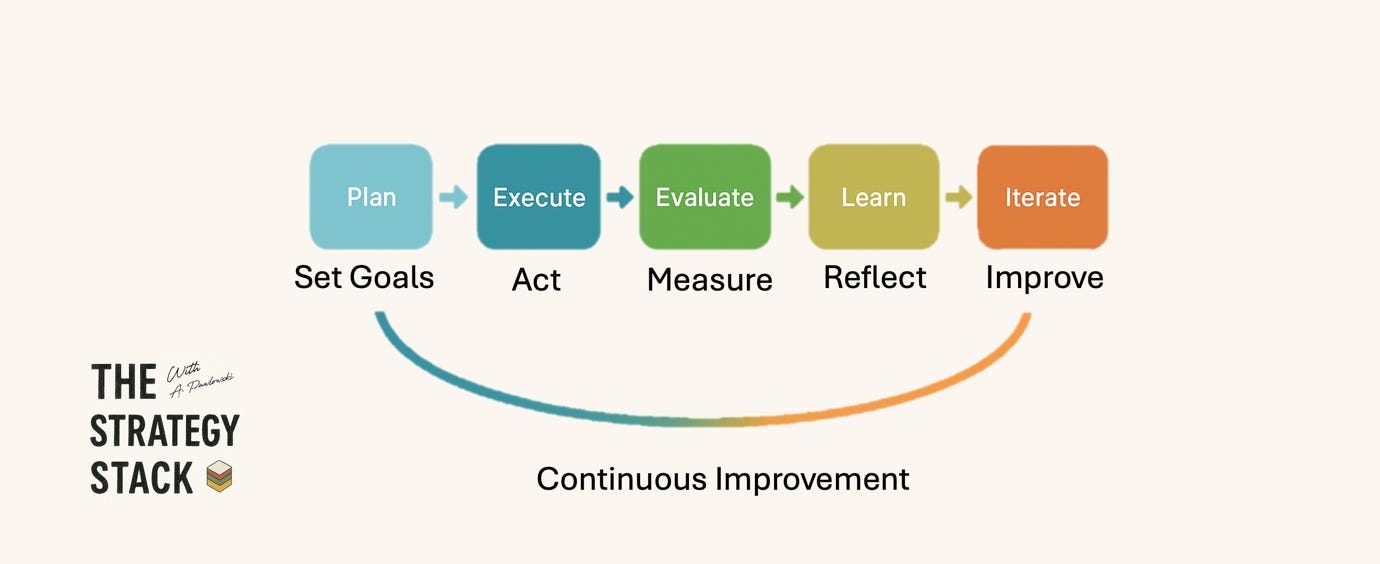
Every loop should have a performance metric (CTR, CAC, code quality score). Without metrics, the flywheel can’t spin.
Example A – The Startup
We defined one metric: dwell time.
Step 1: Connected GA4 to BigQuery.
Step 2: Each post’s dwell time auto-fed into the prompt for GPT rewrites.
Step 3: The top 10% performers became training examples for the next batch.
Step 4: A Slack bot reported weekly performance deltas.
Within two months, dwell time rose 40%.
Example B – The Corporate
Their pilot used Performance Max.
Step 1: Created a feed pulling conversion data into Looker.
Step 2: The model segmented campaigns by audience cluster.
Step 3: After each cycle, it re-allocated 5% of spend toward high-yield clusters automatically.
Step 4: Humans reviewed anomalies via a Monday dashboard.
The blended ROI improved 18% in a quarter.
4. Anatomy of a Self-Running Product
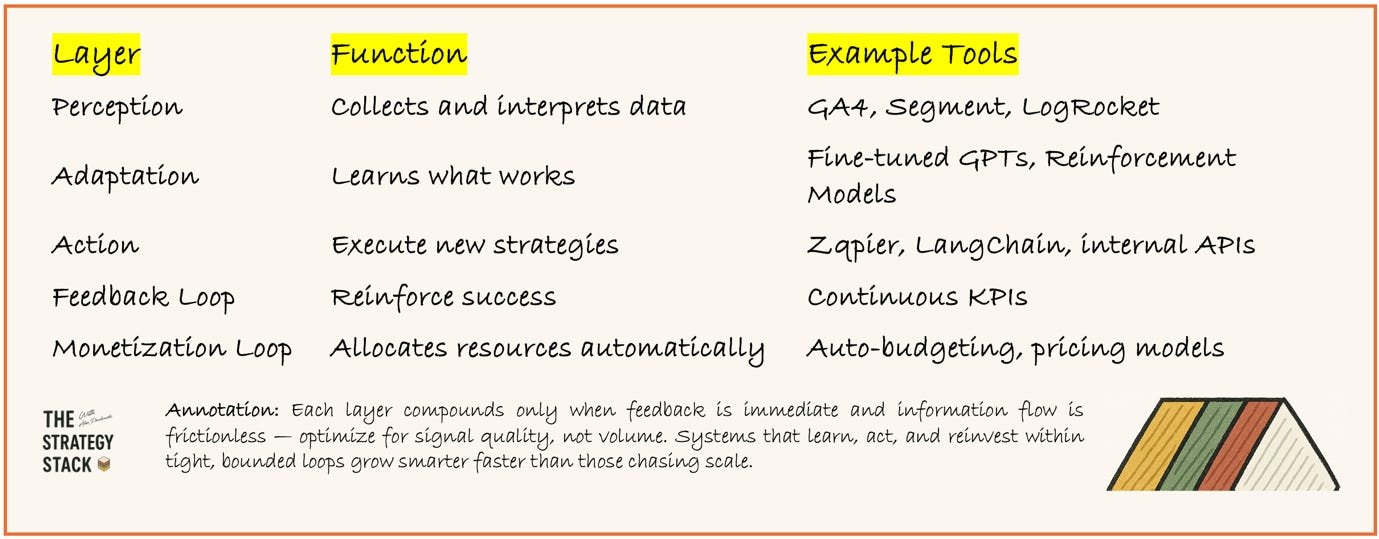
🌀 The strength of an agentic product lies in its closed feedback loop — it learns faster than it can be managed.
Pro Tip
Think modular: Build your system in stacked loops — marketing, operations, and support each with their own self-improvement cycle.
Best Practice
Introduce a “human audit checkpoint” every few cycles to evaluate model drift and ethical implications.
Example A – The Startup
We built three micro-flywheels:
Marketing: ad copy ↔ CTR.
Product: feature usage ↔ churn.
Support: ticket phrasing ↔ CSAT.
Each loop used the same framework — GPT 4-turbo + PostgreSQL logs + Notion reports.
Every two weeks, a “Loop Audit Day” reviewed drift and unexpected behavior. That rhythm became their governance culture.
Example B – The Corporate
We split the supply chain into modules: procurement, logistics, forecasting.
Each had its own reinforcement signal (lead-time, delivery accuracy, cost per unit).
A central orchestration service aggregated scores, and an ethics committee reviewed quarterly drift reports.
Autonomy scaled because oversight scaled with it.
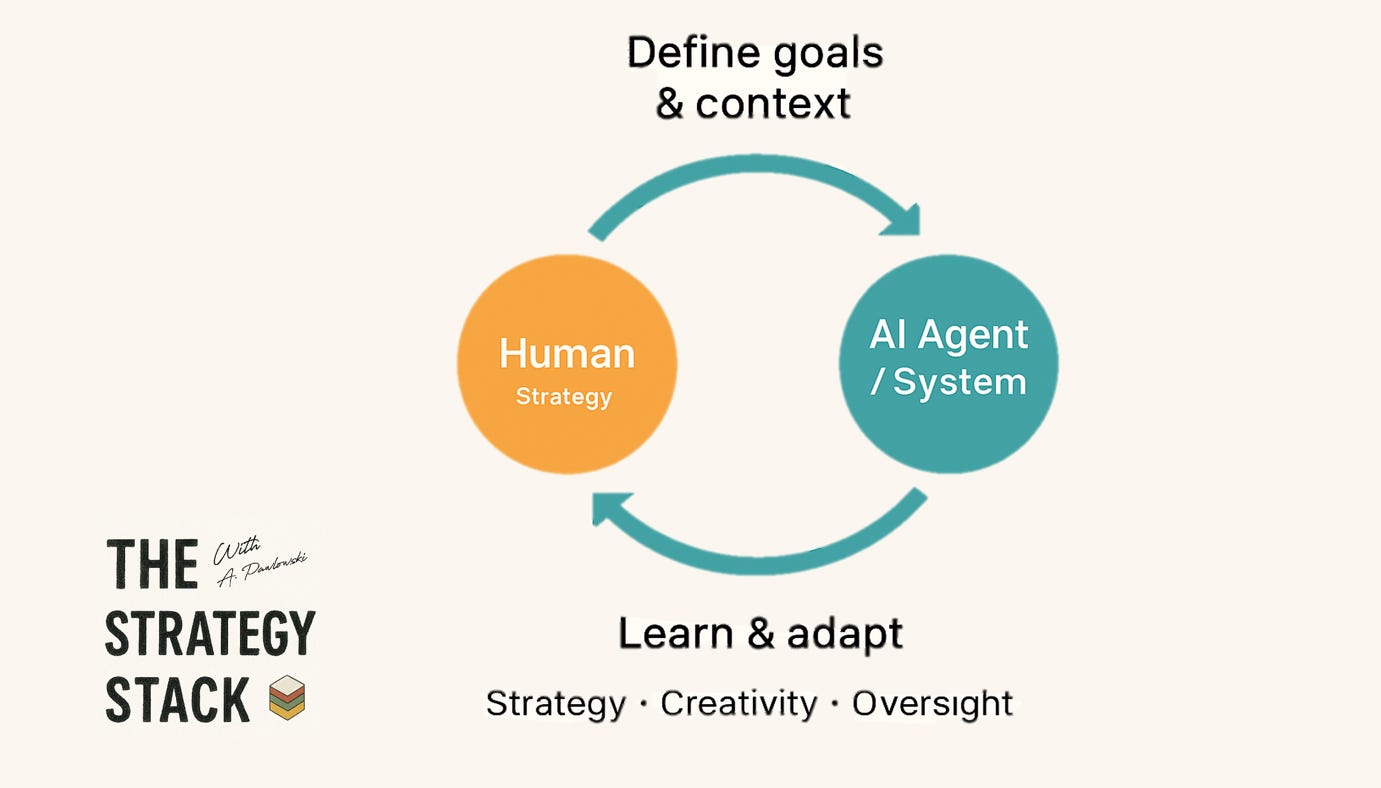
5. From Tools to Teammates
Agentic systems are no longer tools — they’re teammates.
They observe, act, and reinvest based on goals.
They’re not replacing humans but replacing stagnation.
A glimpse at what’s coming:
Marketing agent identifies trends → writes ads → tests them → allocates spend → reports → reinvests — all autonomously.
Pro Tip
Treat your AI like a junior partner: set clear KPIs, reward success, and allow creative freedom within boundaries.
Best Practice
Transparency builds trust. Keep logs of agent decisions to allow post-hoc review or rollback.
Example A – The Startup
We gave each agent a profile in Slack with its KPIs.
Step 1: Echo (the outreach agent) reported daily opens.
Step 2: Humans rated tone quality 1-5 via emoji.
Step 3: Those ratings fine-tuned its prompt weekly.
When Echo hit 28% reply rates, we doubled its scope to partnership emails.
Example B – The Corporate
Their procurement AI, “Hana,” posts weekly dashboards into Teams: “Here’s what I saved, here’s why.”
Step 1: Logs every supplier decision with source data.
Step 2: Managers annotate exceptions.
Step 3: An explainability module summarizes reasoning.
That transparency turned skepticism into adoption — 70% of the team now relies on Hana’s suggestions first.
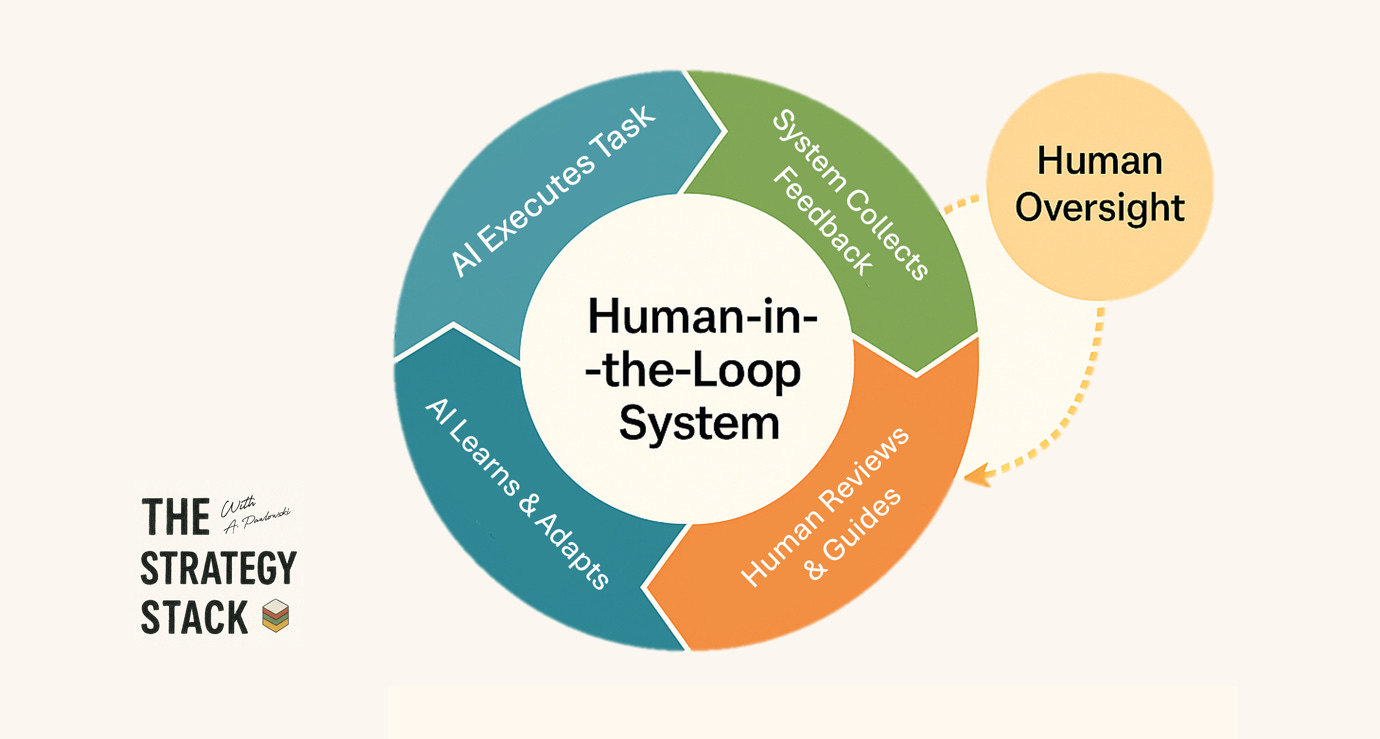
6. Building Your Own Agentic Flywheel
You don’t need frontier AI to begin. Start small with semi-agentic workflows:
Connect feedback to action: Link analytics APIs to generative tools (e.g., GA4 → GPT → content update).
Automate retraining: Feed outcomes back into prompt refinements or fine-tunes.
Reinvest revenue: Auto-adjust spend or pricing based on performance data.
Keep a human oversight layer for compliance and brand alignment.
Pro Tip
Document every loop: define input, behavior, output, and metric. This helps debug when autonomy grows.
Best Practice
Start with “bounded autonomy”: allow agents to act within strict cost or domain limits before expanding.
Example A – The Startup
Implementation stack: GA4 → Zapier → GPT API → Notion DB.
Step 1: Underperforming content triggers a rewrite task.
Step 2: The draft routes to human review.
Step 3: Approved versions auto-publish via Webflow API.
Step 4: Results feed back into GA4 for retraining.
Bounded autonomy = no publishing outside brand tone range or > $200 ad spend.
Example B – The Corporate
Tools: ServiceNow + OpenAI endpoint + PowerBI.
Step 1: Refund requests < $50 trigger AI approval.
Step 2: Every transaction logs to PowerBI.
Step 3: Monthly audits sample 200 cases for error analysis.
Step 4: Model fine-tunes on false positives only.
After three months, accuracy hit 99.3%, freeing agents for complex claims.
7. The Road Ahead — Self-Governing Product Ecosystems
Tomorrow’s startups will sell autonomous outcomes, not software.
Instead of “tools for humans,” we’ll deploy systems that:
Run ads and optimize spend.
Manage content ecosystems.
Build and ship code.
Adjust pricing dynamically.
The differentiator won’t be the algorithm — it’ll be the learning velocity of your flywheel.
Example A – The Startup
Their ecosystem now runs four interconnected loops.
Step 1: Marketing data feeds product-feature tests.
Step 2: Product feedback triggers new content themes.
Step 3: Revenue signals auto-tune pricing.
Step 4: The pricing loop funds ad spend dynamically.
They’ve essentially built a company that learns itself forward.
Example B – The Corporate
Example B’s next phase is a self-adjusting pricing network.
Step 1: Market signals stream in real time.
Step 2: The system models elasticity by region.
Step 3: Deviations > 3% trigger automatic rebalance.
Step 4: Human auditors review weekly variance reports.
Executives call it “controlled autonomy” — not removing people, but removing latency.
Resources to Get Started
Frameworks & Tools
LangChain — for agent orchestration and tool use.
AutoGPT — open-source foundation for autonomous agents.
Hugging Face Transformers + PEFT — for lightweight retraining loops.
Zapier / Make.com — for connecting data-action feedback.
Learning
McKinsey AI Transformation Playbook (2024)
OpenAI: From Models to Agents (2024)
AGPT Labs: Agentic AI Explained (2024)
Arxiv.org: Multi-Agent Optimization Paper (2412.17149, 2024)
Communities
Hugging Face Forum — applied ML and agent workflows.
Reddit r/AutoGPT — practitioner experiments and pitfalls.
Substack Creators using AI — collaboration examples in publishing automation.
📚 References
1. Meta.Meta Advantage+ Suite: Automated Ad Optimization. Meta Business Blog, 2023.
2. IBM. What Is AutoGPT? IBM Think Blog, 2024.
Cognition AI. Introducing Devin: The World’s First AI Software Engineer. Cognition Labs Blog, 2024.
3. OpenAI.From Models to Agents: The Path Toward Autonomous Systems. OpenAI Research Blog, 2024.
4. Arxiv.org. A Multi-AI Agent System for Autonomous Optimization. arXiv preprint 2412.17149, 2024.
5. Social Media Today.Meta Phases Out “Automated Ads” Option, Consolidates Into Advantage+. Social Media Today, 2024.
6. AGPT Labs.Agentic AI Explained: The Rise of Autonomous Decision-Making Systems. AGPT Blog, 2024.
7. xCube Labs. Agentic AI in Retail: Real-World Examples and Case Studies. xCube Labs Blog, 2024.
8. Birch Agency. Guide to Meta Advantage+: How AI Is Changing Paid Social. Birch Marketing, 2024.
9. Reddit Marketing Community.Are You Manually Creating Facebook Ads or Using Advantage+? Discussion Thread, 2024.
10. McKinsey & Company.The State of AI 2024: Moving From Experimentation to Automation. McKinsey Global Institute, 2024.
11. Harvard Business Review. When AI Becomes a Business Partner: Managing Autonomous Systems. HBR, 2024.
 | A guest post by
|
Thanks for the collaboration, Jenny!
Starting small with bounded autonomy...like the ad copy or pricing examples...is a brilliant way to build trust and scale without the massive risk.
Great share..