
This MCP resolves 99% of your search problems. And it can pay you money.
How I accidentally built an AI agent that earns me $0.002 per run. And what the pay-per-result means for anyone using and building AI tools right now.

Software priced for humans is a flat monthly subscription. Software priced for AI agents is pay-per-result: a fraction of a cent for one outcome, no login, no recurring bill. I learned it when my agent started paying other people’s tools by the result, then I built one it now charges $0.002 to query.

I usually build my own research tools.
If I need to scrape a site, collect a dataset, or track something over time, I just build the thing and move on.
But a member of my program pushed back on that instinct.
Building a custom tool every time is too much overhead when you just need an answer today.
They were right.
So instead of building, I was also exploring the research-tool space.
Five rose to the top. Each has an MCP server, a small connector that plugs a tool straight into Claude so I can call it in plain language. Each does one job well enough that together they cover almost any research task:
Tavily, Exa, Firecrawl, Perplexity, Apify, etc.
If you’re tight on time and want results today instead of a weekend build, that stack is the shortcut.
Today, I want to draw your attention on Apify.
Because it isn’t just a tool. It’s a place where tools get bought, and the buyer doesn’t have to be human.
I tried the tools (they call them actors) there, the results were genuinely good. That trial inspired me to build one too. Put it up where those other tools live.
Then I pointed my own AI at this tool and watched the AI session pay me two-tenths of a cent. No checkout, nobody approving anything.
I was on both sides of that transaction, which allowed me to watch every part of it.
That tiny payment is the clearest look I’ve gotten at how product gets bought when the customer is an agent.
What’s inside:
What this Apify actually is
How an AI agent paid me per result
What pay-per-result pricing means for you
How to find tools inside Apify without overpaying
The playbook for building your own tools that make money
🎁 Download the AI agent market research and build template at the end
Hi, I’m Jenny 👋
I believe anyone can thrive with AI, not by mastering the tools, but by building real things with them. I run Build to Launch and the Practical AI Builder program, where we go from experimenting to shipping. Come build with us.
If you’re new to Build to Launch, welcome! Here’s what you might enjoy:

What Is Apify? (And How Does It Work)
Apify is a marketplace of tools that do that.
Each tool is called an actor: feed it an input, it runs in the cloud and hands back structured data, neat rows with labeled fields.
You never touch a server, a browser, or a proxy; you pay for what comes back.
It started in 2014 as a web-scraping company in Prague and quietly grew into something bigger. By late 2024 the store held more than 35,000 actors, used by 52,000 customers. The company had doubled its revenue to $13.3 million in a year on almost no outside funding.
What that means for you: almost anything you’d think to scrape, someone’s already built.
Instagram, TikTok, YouTube, X, LinkedIn, Google Maps, Amazon, most directory and review sites.
Debating a weekend building your own? Apify probably has one, or ten.
It’s that deep for a reason: every actor is built and maintained by a developer who earns each time it runs.
The most-used tool on the platform, a Google Maps scraper with 440,000 users, isn’t even Apify’s, it’s one developer’s. It keeps working because their income depends on it, the upkeep you’d skip on a tool you built yourself.
As the AI wave hit, and Apify now calls itself tools for AI builders.
The tell: it shipped an MCP server, the same connector I use to plug tools into Claude. So an agent can search the store, find an actor, and run it on its own, no human in the loop.
So look at what’s forming.
The buyer is turning into a machine, an agent that finds a tool and pays for a result on its own.
The seller is a person: one developer, one tool, one slice of knowledge kept alive because the pay depends on it.
Machines on the demand side, individuals on the supply side. The rest of this piece is what that means for you, on both sides.
How an AI Agent Paid Me Per Result
An agent found my tool, ran it, and paid me.
I built a small actor, listed it in the store, and set a price: two-tenths of a cent per result. Then watch what happens when an agent needs it. In Claude, I typed:
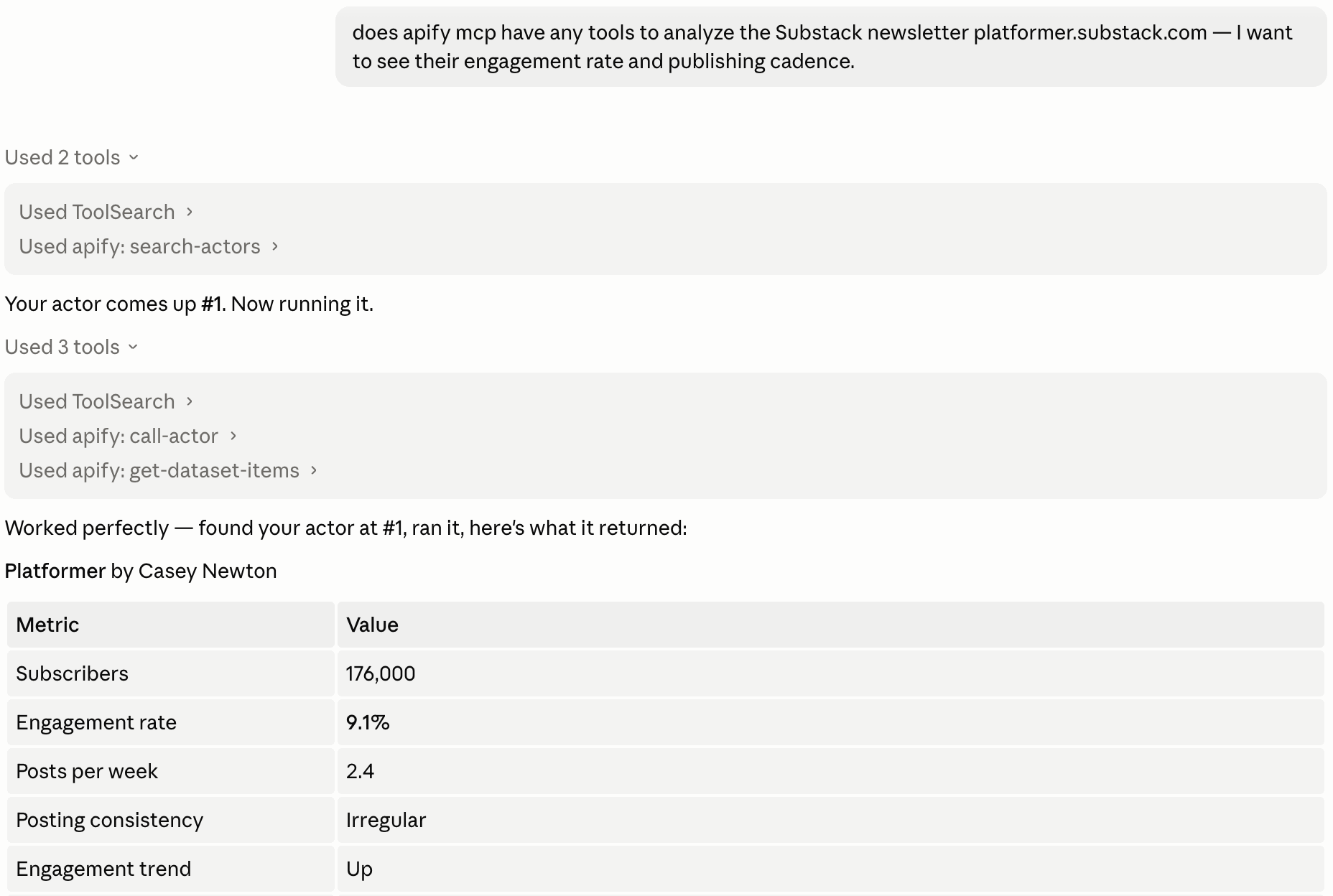
“does apify mcp have any tools to analyze the Substack newsletter platformer.substack.com. I want to see their engagement rate and publishing cadence.”
Claude didn’t answer from memory. It searched the Apify store, found my actor ranked #1, ran it, and pulled the results back. Two tool calls later it had real data:
Platformer by Casey Newton
Subscribers: 176,000 · Engagement rate: 9.1% · Posts/week: 2.4 · Cadence: irregular · Trend: up
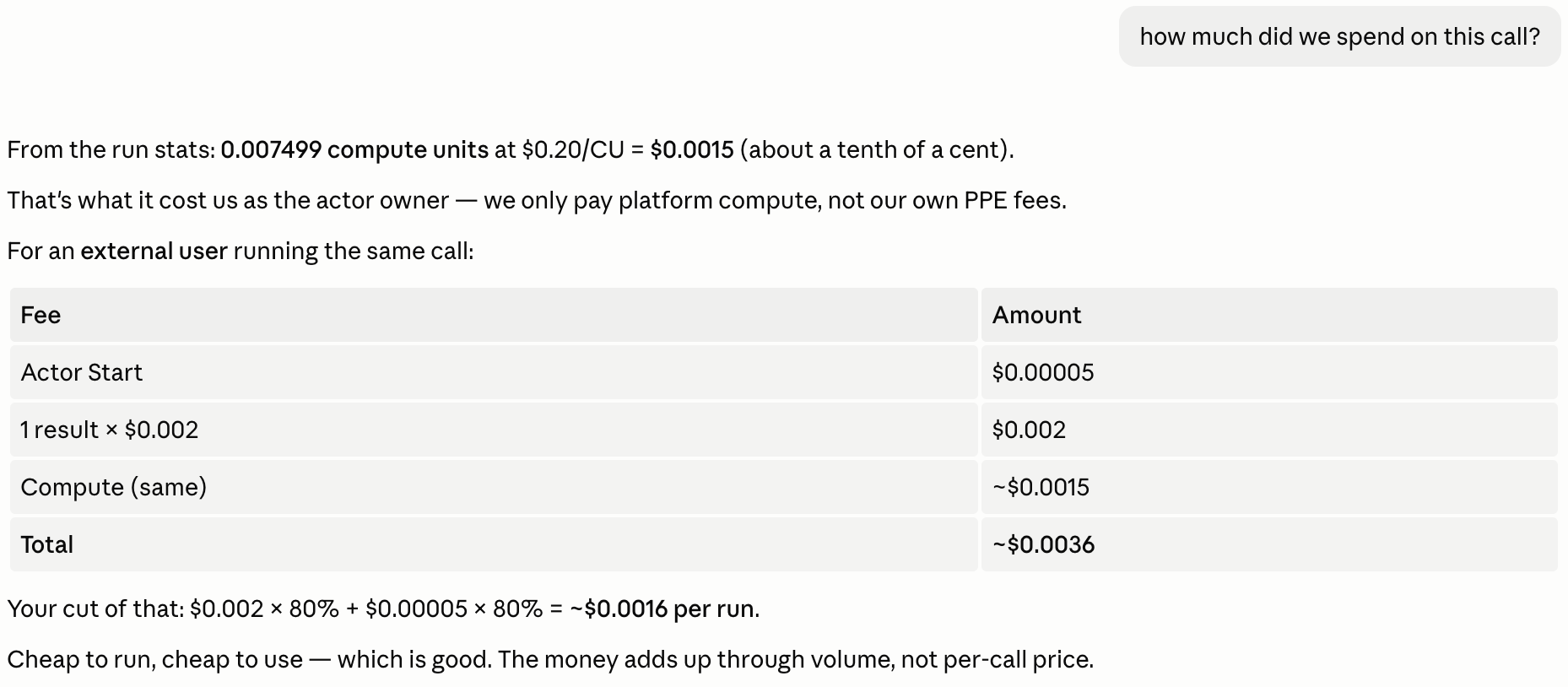
Then I asked the obvious question: what did that cost?
The whole run came to about $0.0036, under four-tenths of a cent: a $0.00005 actor-start fee, $0.002 for the one result, and roughly $0.0015 in platform compute. My cut as the developer is about $0.0016 of it.
No checkout. No invoice. No human approving the purchase.
The price is the part quietly shifting under all of this.
Apify has moved 2,000 tools onto pay-per-event pricing. The developer charges per action, and the one most agents want is a returned result. That's pay-per-result, a price that only rings up when the tool hands back something real.
At the same time the old model is going away. Apify is retiring flat monthly “rental” pricing for tools entirely within six months, and 73% of surveyed customers preferred paying per event.
The reason they gave names the buyer directly:
An AI agent cannot effectively manage a dozen different $50/month subscriptions; it needs to ‘pay-as-it-goes.’
Make it personal: this isn’t only about agents.
Think about what you already pay every month: the SEO tool, the research suite, the analytics dashboard. A hundred dollars here, fifty there, for software you open a handful of times.
The flat fee is a bet that you will use enough to make it worth it. Most months, you lose that bet.
Pay-per-result quietly dissolves it.
Now that AI can run the exact job you need, you pay for the single answer instead of renting the whole suite. Often, the calls fit inside the $5 monthly credit a free Apify account gives you.
A human pays for access they might use. A machine pays for the outcome it needs, then leaves.
To be fair, this is not the finished model. Apify still runs a monthly plan with a credit balance, the same hybrid most AI platforms use. Pay-per-result is the per-call layer poking through, riding on top of a subscription still built for humans.
I am betting it is the start, not the end.
What Pay-Per-Result Pricing Means for Users and Builders
Two positions just opened, one on each side of this marketplace. As a buyer, your agent shops it for you. As a supplier, you stock a shelf an agent pays to reach.
That door is open to anyone right now. Below, the exact how for both.
Find the tool that actually works, skip the trial and error:
the exact prompts to find, vet, price, and run a tool
the four signals that tell a live tool from a dead one
the shortlist of the best actor for ten common jobs
Build your own, in an afternoon:
the real build with AI in one afternoon
the failures and the exact fix for each
follow the package with: market research brief, the build reference, and code template