


Welcome to Build to Launch Fridays, where we meet the builders turning domain expertise into AI-powered products.
Every Friday, I’m spotlighting someone from the vibe coding builders collection who’s doing exactly what I believe is the future: using AI not as just another tool, but as a true collaborator to transform curiosity, passion, and years of professional knowledge into something scalable and ownable. No VC funding, no technical co-founders, no permission required, just domain experts who decided to build.
Today, meet HipsterTech — a former CTO with 15+ years in tech who made an unexpected pivot from startup life to building products that prioritize human connection and fulfillment over profit.
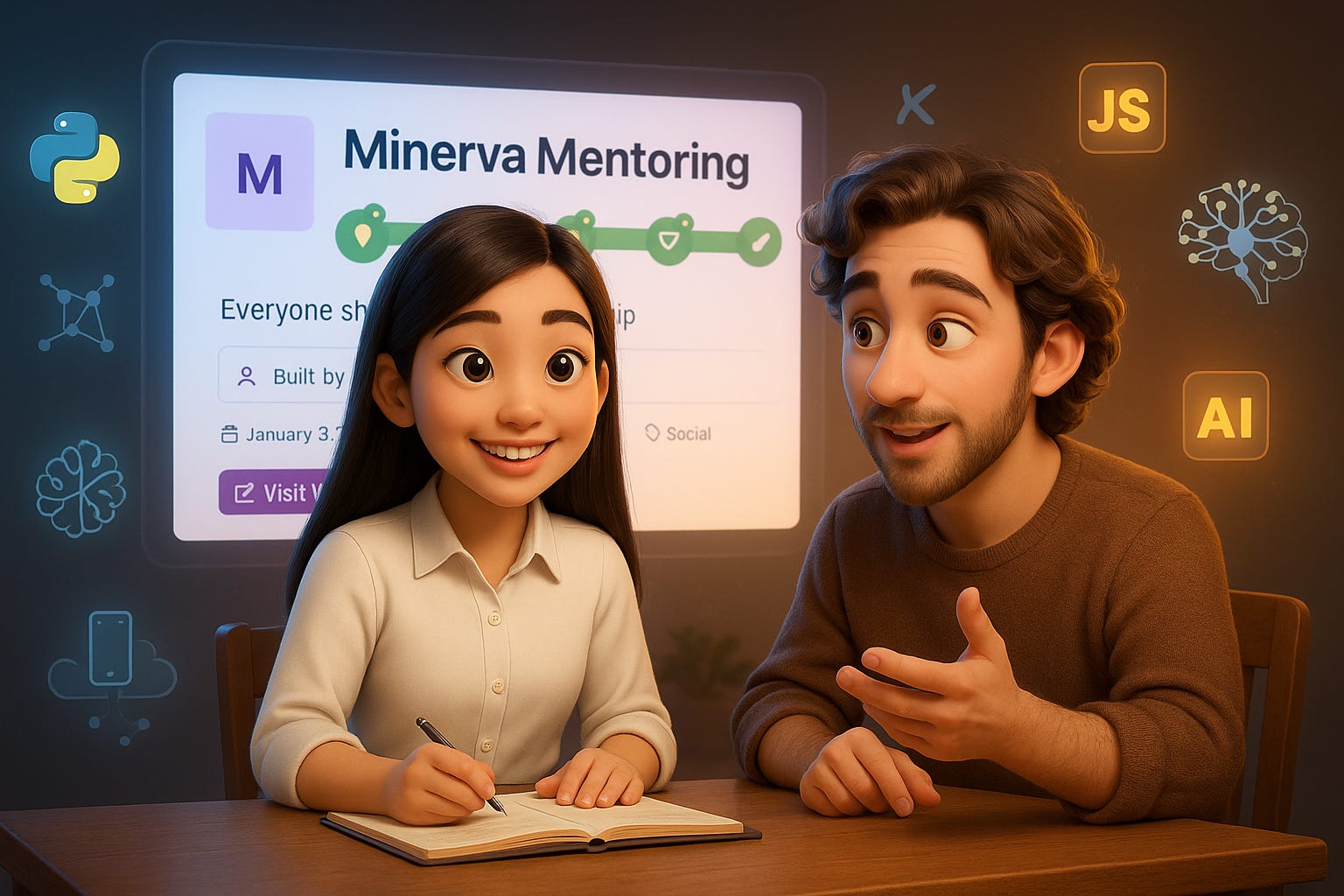
What happens when a seasoned CTO steps away from the startup grind to ask deeper questions about success and meaning?
HipsterTech’s story challenges everything we think we know about the “right” path in tech. With over 15 years of experience spanning iOS development, backend systems, and startup leadership, he reached a moment that many senior technologists face but few act on: the realization that optimizing for growth and profit might not be optimizing for what actually matters.
After five intense years wearing an entrepreneur hat, he made a counterintuitive move. Instead of doubling down on the next big startup idea, he stepped back, took an individual contributor role, and began what he calls “major soul searching.” The result? Three products that embody a radically different approach to building: Plainews (a distraction-free RSS reader), Shrink Wrap (AI tools for mentors), and Minerva Mentoring (a community-driven mentoring program that’s his true passion project).
I’ll be honest: I don’t often get to catch a grinding CTO in the wild. So when I sat down with Nikola, I asked everything I’d been curious about; partly to pick his brain, partly to get a feel for what that life is really like.
This turned into a long one. Not just about building, but about philosophy, industry shifts, and the mindset changes that come after stepping off the startup treadmill. Think of it as a guided tour through someone’s head: tech depth, reflections, and a few laughs along the way.
Here’s what we cover:
Builder Background → how Nikola got started in tech and what shaped him.
The Pivot to Fulfillment → why he stepped away from the tech grind and what he builds now.
Evolution of Tech & AI → his take on industry shifts, from Agile to AI.
Tools & Building Process → what he actually uses day-to-day.
Projects on VibeCoding Builders → the ones closest to his heart (including Minerva Mentoring).
Business & Strategy → costs, users, and what success looks like beyond vanity metrics.
Future Vision & Sustainability → how he plans to scale mentoring without losing the human connection.
Advice & Reflections → his recommendations for new builders and what fulfillment-first building really means.
It’s got philosophy, revolutions, and a rare peek into a seasoned techie’s thought process. Hope you enjoy!
Builder Background
Can you tell me more about your background? How many years have you been in tech, and when did you first get involved?
I’m very much the cliche in this regard. My father is in tech and I grew up watching him play around with computers. He was a system administrator for some enterprise servers in a bank. So not really a developer. He also didn’t necessarily introduce me to IT or teach me stuff. Still, it was enough for me to get interested and when it was time to choose a high school, I chose one with an extensive computer science program. Later on, I went on to study CS in university.
I’ve always been really hands-on and I was super eager to get real life experience so I started my first development internship when I was 16. By the time I was in my second year in university, I had essentially a full time job as a developer. At that time, it was all about iOS development. This is something I did for many years. Later on, I switched to backend development and in late 2019, I got more involved in the entrepreneurship side of things by joining an ex-colleague of mine in his (very early stage) startup.
Overall, depending on how you measure it, I have more than 15 years of experience in this business.
Starting at 16 with real development work? That’s the kind of early hustle that builds the deep technical foundation you can’t fake later. As a “late starter”, I always feel the deep respect to those talented “kids” who start early and already know what to do.
You’ve described yourself as being very deep in tech, and you’ve been a CTO. Is being deep in tech something mostly required for a position in CTO?
There are different types of CTOs. In an early stage startup, it’s a very much hands-on role. I’ve written more code as a CTO than I have in any other role. Of course, in a bigger company, a CTO would struggle to even write a single line of code.
Technical expertise is the foundation of a good CTO. No one wants to follow a leader that doesn’t know how the sausage is made. As a CTO, you are responsible for all technical decisions in the company, even the ones you didn’t make. That’s why it’s important to, first of all, have people you trust that you can delegate decisions to, and to find a way to keep an overview of what’s happening in the system.
Obviously, it’s possible, and it also happens that a CTO is not as deep in tech, and it does work for some companies, but this is not what I stand for. For me, it’s very much a “leader vs. manager” thing. And I also love software development - I’m not trying to get out of it.
“I’m not trying to get out of it”: this hits different when so many technical leaders see coding as something to graduate from. I’d naturally feel more connection with those staying connected to the craft even as you level up.
The Pivot to Fulfillment
What is your current daily job, and how does it relate to your current product-building?
My entrepreneurship journey is now on ice. I don’t run my own company. I’m not even so much in the startup scene right now. After 5 years as an entrepreneur, I did some major soul searching and my current role gives me space to figure out what I really want to do in life. This is also why you see me post about fulfillment, emotional intelligence and soft skills. I went back to basics and I have a regular IC (individual contributor) role.
How it relates to my product-building is an interesting topic. Building a company from zero is such an emotional rollercoaster. And it’s such a strain to constantly struggle to beat the odds and survive. Also, in the startup world, the incentives are different. It’s all about achieving Product-Market fit, getting investor money or becoming profitable. You cannot write code just for the sake of the code itself. Like the famous “What’s the user value from this ticket” question that Agile teams love so much. It’s fun, but there’s also a lot of fatigue from this after a while.
I remember when I started working on my first project after that - Plainews. It’s a text-based RSS feed reader with focus on a distraction-free news reading experience and smart features that let you get informed without all the bloatware like constant ads and watered down articles. Good luck pitching this to an investor. There’s no money in that. Text-based interface? Forget it - too niche. I didn’t care, though. It was something for me and I didn’t care too much if someone else would use it. It was all about playing around with tech and solving a problem - even if it was just my own.
My other projects are an extension to the same principle. There are a lot of things I don’t enjoy or care too much about in entrepreneurship - the huge payout, the risk, the glory. I just want to work together with people, to lead and to have influence on what I’m building. So when I build in public, or when I run a mentoring program without worrying about getting paid, or when I play around with tech, what happens behind the scenes is - I optimize for fulfillment, not for monetary gain. I’m happier like that.
This is so refreshing. Building just for yourself is something I’ve been hoping for more, and I think AI will only boost that since it democratizes building. Not everything has to chase product-market fit, sometimes we build quietly for ourselves, sometimes for an audience. Both are valid. That’s why Nikola’s approach resonates so much with me, even though he comes from a very different background.
Evolution of Tech & AI
You must have seen a lot of changes in how products are built over the years. How would you sum up that evolution?
As they say - you will be surprised at how much changes in a year and how little in 10 years. I’d still say AI is the first really major shift I’ve seen. I started my career after mobile had already established itself (just as iOS 4 was being rolled out). When I switched to the backend, hyperscalers like AWS were already the norm.
Organizationally, we have seen Agile replace Waterfall and I’m happy to see more and more companies adopt self-organization, flat hierarchy and high-trust collaboration.
On an individual level, a funny anecdote is that in university, it was all about becoming an expert in a narrow set of skills. To be highly specialized. Heaven forbid you didn’t know your programming language inside out. In the workplace, this was a bit different, but still, being an expert in your niche was very appreciated.
Now, with more cross-functional teams and with so many startups, generalists are becoming more and more valuable. And in the age of AI, Claude can already write better <insert programming language> code than you. So the valuable people are the ones that can think across domains and have a more holistic view of a whole project.
As an entrepreneur, I’m glad to see people realize the value of iterating fast, listening to users and validating hypotheses. I’m a huge advocate for this. This is basically the rise of the Lead Startup methodology.
I’m so glad I asked this question. The way he describes the shifts: new methodologies, new languages, new ways of working, really shows how much has changed in such a short time. It’s wild to think that what feels fresh and inspiring today—agents, new tools, new tech—will eventually become the norm, and maybe even outdated sooner than we expect. That’s exactly why we stick around in this field: to keep learning, to avoid getting stale, and to not fool ourselves into thinking today’s comfort will last forever.
From your perspective, what have been the most important and useful changes: languages, frameworks, or approaches?
In the past, people expected perfect specs, well written tickets are roadmaps carved in stone for the next years. Now, we realize that the world changes too often and that we have no idea what we are building and for whom. We embrace iteration and well… chaos.
The tooling has also become way more accessible. Very mature frameworks and tools everywhere. You don’t have to fight low level problems - you just focus on the features that differentiate you. Infrastructure is the best example here. You don’t need to be a system administrator and network specialist to run services at global scale.
Languages are a funny one. There are many, parallel and often conflicting schools of thought. I’ve worked with a lot of strongly typed languages. In that camp, it sounds insane that you might not know what type of data you’re working with. Then I started getting into Python. There, it’s like the wild west. You could specify a type… or not. You can write the most nonsensical piece of code and Python is perfectly happy to drive that car into the wall. However, after you spend some time with it, you start to get it. It also allows you to move fast and not fight the type system all the time. It’s like bureaucracy.
We are also going in a more functional direction. Here I mean functional programming. It’s popping up everywhere. My all time favourite language - Kotlin, is highly functional (in a good way) and it’s awesome.
So there are so many choices nowadays, and they are all awesome. You can choose many languages for a project and for many of them, it would not be a bad choice. I don’t think this was the case in the past.
I’ve heard really good words about Kotlin, but never tried it myself. But one thing I hands down agree: there are so many choices nowadays, any choice would not be a bad choice.
Do you think AI coding has captured the best of those evolutions?
More often than now, yes. Look, developers are lazy. We don’t like boilerplate and we don’t like writing stupid code all the time. It’s not like I cannot traverse a tree or write some sort of algorithm. I just don’t want to. Now, with AI - I can just tell it to write it for me. It’s like importing a library, but it’s completely custom code and I don’t have to hope someone else had the same problem and built a library for it.
It’s the same with languages. Above, I wrote how there were many cool languages nowadays. Learning them is not a big deal, but sometimes I cannot be bothered to do so. I have a ballpark idea how something should look like. The rest, AI can help me with. We are so much more productive like that. And yes, of course, then you don’t learn the perfectly Pythonic way to implement a queue… but who cares?
This is the honest truth about AI coding that more people need to hear. It’s not about being lazy - it’s about focusing on the interesting problems instead of the repetitive ones.
Tools & Building Process
What tools do you generally use for coding and building?
I’m a bit of a purist. You will not see me have fancy setups, use elaborate productivity tools and techniques. I don’t even have a multi-monitor setup. Not even a mechanical keyboard.
Most of the time, I have an IDE, a terminal and a browser for my coding and building. I’m a Jetbrains guy, so you will often see me with IntelliJ, PyCharm or recently GoLand. VS Code I use for some things, and I generally like it, but I still find myself coming back to JetBrains.
Recently, I switched to Linux after a decade on Mac OS and I’m loving it. I’ve always been a Linux fan, but between iOS development and not being able to take the extra few hours to make sure everything runs smoothly, Mac OS took over my life for a while.
Wow, that is truly purist. I’ve touched most of the IDEs described here, but I’ve forgotten most of them, and now I almost only stick with Cursor…
Projects on VCB
On the VibeCodingBuilders platform, you’ve submitted three projects. Which one do you feel most connected to, and why?
Minerva Mentoring, for sure. This is something I’m really passionate about and I’ve already met some amazing people through it. I’m already mentoring a few people and I’m involved in some mentoring programs, so this is something I’m doing anyway. Minerva Mentoring is just a way for me to be more in the driver seat and organize something that follows my own vision.
Another benefit is that there’s only so much coding you can do in a day. I personally cannot do it for 12 hours straight. With mentoring, it’s more about talking to people - more organizational. And whereas it often puts me way out of my comfort zone - approaching people, going on stage, doing networking, it also brings a lot of variety in my life. It allows me to relive my entrepreneurship past, but without all the stress and problems. It’s almost as if I filtered out all the things I didn’t enjoy back then and took only the good parts.
It’s striking how you can spend so many years in one field and then suddenly feel it’s no longer the right fit, leading to a completely different direction. AND with AI accelerating everything, it feels like these realizations and the life changes that follow will only become more dramatic.
Which project cost you the most—considering both the build process and ongoing hosting?
Let me tell you - if you need someone who can tell you how to do something for free or on the cheap side - I’m your guy 😀. I’ve spent so much time building on a tight budget, I know all the ways to avoid costs.
It also doesn’t hurt that I’m a fan of open source and I’m not afraid to get my hands dirty and do stuff on my own (although I often pay for that in other ways 😀).
So for personal projects, I mostly manage to do it for free. Plainews for sure. For Minerva Mentoring, apart from travelling and going to events, probably so far it’s only been the money for the domain I bought.
Sweet!!! I think I’ve found the guy 😄. I’ve always tried to keep things as cheap and free as possible, and so far it’s worked out. But if I ever need to learn the really hacky tricks, I know exactly who to look to.
Let’s take Minerva Mentoring as the focus: how many days did it take to build and launch?
It took me a while to get off my behind and start connecting with people, that’s for sure. I’m an engineer after all :P. Aside from this, on the technical side, this is the closest I’ve gotten to pure vibe coding. Even though I worked as a mobile developer, web frontend is my kryptonite. I cannot center a div even if my life depends on it. When I decided to create Minerva Mentoring’s website, I was happy to try out Vercel’s v0. This is probably the first time AI truly amazed me for coding. It still took me a few weeks of working on it on and off in the evenings before it started shaping up.
I feel you! My very first vibe coded project (a hard core one too!) took less than a month, the others that follow just took less and less time. Crazy times.
Roughly how much money did Minerva Mentoring cost you?
Just the ~12 dollars for the domain name. I used the free tier of v0. It’s relatively limited - you can only make a few dozen prompts per day. Still, it was enough for me since I was only working on it for a bit in the evening. It also helps that for many things I could look at the generated code and make manual changes. The perks of being a developer, I guess.
~$12 for a fully functional website is so real for someone deeply technical. If you are non-technical, let’s be a little more realistic and aim for… less than $100 :)
Business & Strategy
Since launch, how many users have joined?
It’s still very tiny. I’m still figuring things out. There are 5-6 amazing people I talk to on a regular basis. I assembled the first mentoring pair a few months ago, I’m personally mentoring a few more and next week we are launching a pilot project for job seekers. It’s based on the “Never Search Alone” framework from Phyl Terry and it’s a joint venture with a local professional network for design professionals called Employed.world.
It’s a real solid drill. Readers, would you like to join his lead?
What success metrics do you use to measure the value for people joining your application or space?
For an application or a service, it really depends on the project, but if we talk about a metric that applies more generally, I’d say activation. Many people focus a lot on DAU, WAU and MAU (daily, weekly and monthly active users). This metric is often flawed and I wish I realized this sooner. Activation refers to the AHA moment, or the moment when a user “gets it” and becomes an active user. For instance, the activation metric for Facebook used to be having 5 friends within a week of creating an account (or something similar). They found that having 5 friends that fast correlates with sticking to the platform. So they started optimizing for that.
For a non-software service like Minerva Mentoring, it’s easier in many ways because I have a personal connection with each new member and I can see first hand if they resonate with my initiatives. You can see it in their facial expressions and the way they talk. More often than not, it’s about hearing “Wow, thank you so much! When can we meet again?”.
The activation there is to already provide value to people in the first meeting, and for sure before trying to schedule another meeting. If I want to get someone to become a mentor for Minerva - why not give them a mentoring session myself beforehand? Let them sample what the program is all about.
In general, my vision for the program is that everyone needs to benefit from it. The fact that you’re a mentor, doesn’t mean that you only give. This is my way of achieving that.
Wow Nikola, you really have a gift in mentoring!
Did you launch this product on any platforms (like Product Hunt, etc.)? If yes, how many users came from that?
It would be so much easier for me if I could just post on reddit or whatever. Unfortunately, these haven’t been good channels for me. Maybe people don’t “get it” like that. Or it’s too niche. I’ve even tried to reach out to communities via friends. Crickets. For instance, I asked a friend of mine that’s an organizer for the local PyLadies. She brushed it off. I went to a Python Meetup and made a lightning talk about it. Many people approached me and asked me about it after. Then no one applied or followed up.
Then, I approached local coding bootcamps and a mentoring community for designers. That was an absolute gold mine. Everyone wanted to talk to me. Everyone followed up and many people also referred others.
This goes to show that you need to find your niche. If things are not working out, it could be that it’s the audience. But be careful with that - when the product is bad, it’s tempting to blame the target audience, but more often than not, there’s no magic niche that can save you.
This answer is gold to me. It makes perfect sense why coding bootcamps and mentoring communities responded so well, they already live the problem. That’s exactly the kind of resonance I’m hoping to see with vibecoding.builders too.
Future Vision & Sustainability
Where do you see this product going in the next year?
Right now, I still do a lot of the work myself. This does not scale. I want to train the next generation of mentors and enable them to perpetuate the vision. I also want to supplement that with technology and provide tools for the things that can be automated. This is where my other project (Shrink Wrap) comes in. Right now, it’s a collection of Custom GPTs that help people with things a mentor guides them through. For instance, we often work on SMART goals. It usually takes a session or two to convert a non-SMART goal (like “I want to learn more about Python”) into a SMART one (like “In 6 months time, I want to have built a CRM system for my business in Python”). The reality is that you don’t need special skills to guide people through that - you just need to ask a few questions. It’s perfect for a CustomGPT. Another one is to guide a job seeker towards finding their Candidate-Market Fit. This is from the Never Search Alone framework I mentioned earlier.
It’s a perfect example of AI aiding humans, not replacing them. No one wants a machine as a mentor. You want a person to talk to. But if that person is not there, or you don’t want to spend precious mentoring time, offload the monkey work to AI.
For readers who’s interested in it, Shrink Wrap is an open source github repo, so if you want to steal Nikola’s formula, it’s right there!
The way you describe it, I can see how powerful this application and its orchestration could be, like running decisions and measurements autonomously, but still grounded in human awareness.
How do you plan to make the project sustainable for yourself over time?
Maybe I believe in karma too much :D
Jokes aside, I don’t think my projects fit a monetization scheme. It would completely ruin them. I do them because I like them. The point where they become sustainable is more meta.
For me, the pay-off is more indirect. My belief is that immediately thinking about personal gain is not the best approach. Think of startups that focus entirely on the user. This also goes against the sole purpose of a company - making a profit. However, time and time again we see that forgoing profit for a long, long time is exactly the right strategy.
I have seen first hand as well how putting personal gain aside for a while pays off ten fold in the future. That’s also how I got into entrepreneurship. An ex-colleague of mine was starting a company and asked me to join as a developer. I said I was happy at my employer, but I stuck around because I knew how hard it was to build a product and to assemble a tech team. I did it out of compassion. And that’s exactly how that founding team remembered me - with gratefulness and compassion. Soon after, they trusted me enough to ask me to join as the CTO. Had I told them I’d help out with vision and hiring, but only if they paid me, that wouldn’t have happened.
It’s understandable that people don’t want to do stuff for free. It’s only feasible if they have free time, and not strapped for cash and, most importantly - they have passion for what they do. On the other hand, there are so many people grinding LinkendIn or Substack or whatever, posting 20 times a day, for free, in the hopes that they will gain popularity and get better professional opportunities. My question would be - how is that different from helping out a friend for free, or offering free mentorship, or getting involved in a local community?
So these initiatives, if we speak in pay-off terms, for me are a way to put myself out there and become a “voice” in the areas that I enjoy and am interested in. I find it much better than posting motivational quotes on LinkedIn.
I have such mixed feelings about this. At first, I thought of it in simple categories: some people you just become friends with, some you’re friends with but also charge for what you offer, and others you don’t befriend at all — it’s just a transaction that benefits both sides. But the way he contrasted posting 20 times a day for free vs. actually mentoring for free really hit me. It shows that, in the end, it’s not about the format or the channel — word of mouth, posts, mentoring — it’s about the value that gets delivered. That’s what really lasts.
Advice & Reflections
For someone with no coding experience, what tools, languages, or frameworks would you recommend starting with?
It has never been a better time to start coding. AI aside, the ergonomics have become so good - high level languages, countless tutorials and mature libraries and frameworks for any feature imaginable.
I would always recommend DOING, instead of just learning about stuff. There’s nothing better than getting your hands dirty. For learning, I would actually avoid courses and even books. All the information you need is 100% available, for free, from official courses. You don’t need a fancy book about React or Django or whatever. All these tools have extremely helpful official documentation. But hey, if you learn better by watching videos or following a tutorial, go for it.
Here’s a hot tip for you from the Jenny Ouyang universe - On Vibecoding.builders, there’s a really cool app that allows you to generate a custom course for yourself with youtube videos, based on a topic and experience level. I’ve had some fun with it: https://learn-flow-coach.lovable.app/
For languages for beginners, I like Python. Javascript/Typescript is also a good choice, especially around the rise of Next.js, Node.js and the likes. I think these are the technologies that you cannot make a mistake with - alongside React, Angular, FastAPI and so on. When it comes to deploying your applications, the hyperscalers like AWS, Google Cloud Platform and Azure can be daunting in the beginning. You can invest the time to learn them and they usually have easier to use parts like Lambdas, Elastic Beanstalk and so on. However, an easier deployment you would find in services like Heroku, Fly.io, Railway and Vercel. My recommendation would be to cut some corners on infrastructure for personal projects and ease into DevOps - otherwise it’s a very steep learning curve.
“DOING, instead of just learning about stuff” — this should be printed on every coding bootcamp wall. And yes, official documentation over fancy courses is underrated advice.
Also, really appreciate the shoutout to the ‘AI Learning Coach’! The creator isn’t even in the Substack space, so I’m excited to run over and let him know you tried it out and loved it.
What strikes me most about Nikola’s journey isn’t just his technical expertise or even his willingness to step back from the startup grind. It’s his clarity about what actually fulfills him. In a world where success is often measured by funding rounds and exit valuations, he’s chosen to optimize for something much more sustainable: genuine human connection and meaningful impact.
His approach to building reflects this philosophy perfectly. Plainews exists because he wanted a better RSS experience, not because it fit some investor thesis. Minerva Mentoring grew from his natural inclination to help people, scaled through AI tools that handle the repetitive work while preserving the human connection at its core. This is what domain expertise + AI collaboration looks like when it’s driven by purpose rather than profit.
The $12 total cost for a platform that’s already creating mentoring relationships and launching pilot programs should make every over-funded startup question their approach. Nikola shows that the most powerful combination isn’t technical skill + venture capital—it’s domain knowledge + genuine care + smart use of AI to amplify what you’re already good at.
If Nikola’s fulfillment-first approach to building resonates with you, connect with him. He’s exactly the kind of thoughtful builder worth knowing.

If you’re turning your expertise into products, building with AI, or helping others do the same, you belong here. Join the vibe coding builders community and get featured on Build to Launch Friday. Curious why it all started? Here’s the full story behind Vibe Coding Builders.
Your turn:
Have you ever stepped back from a “successful” path to pursue what actually fulfills you? How do you balance building for users vs. building for your own satisfaction? What would you build if investor-friendliness wasn’t a consideration?
Nikola went from startup CTO to fulfilled builder creating meaningful connections for ~$12. What will your builder story be?
— Jenny
If someone is interested in mentoring, gaining access to ShrinkWrap - my customGPT telegram bots for SMART goals, dealing with negative thoughts and job seeking Candidate-Market Fit, feel free to reach out to me 😊
Great article! Thanks for bringing Nikola's story to light Jenny!
Nikola - I love how you now seem to be guided by what your users actually need rather than what shareholders think is wanted. 🙏