
How to Do Research With AI Effectively: 3 Questions Walked Through Live
A practical AI research framework for learning, finding specific answers, and pressure-testing ideas, with live walk through

Most people are already using AI for research, whether they call it that or not. Perplexity. ChatGPT. Claude. Gemini. Google. A question comes up, they open a tool, type something in, and hope the answer helps.
But the friction shows up fast.
How do you turn a big desire into a clear question?
How do you get out of tab-stuffing mode and actually move the needle?
Which tool should retrieve, which one should synthesize, and what kind of data is worth collecting in the first place?
How do you know when you have an answer that’s worth acting on instead of just another plausible paragraph?
Those questions are not new. They existed long before AI. What’s changed is that AI makes them much easier to answer if you know how to route the work.
At the start of this session, I ran a quick poll in chat and asked what people currently use for research. The answers came back as combinations: Claude and Perplexity. ChatGPT and Google. Forums and communities. Almost everyone was already using multiple tools.
That was the point. The tools are already here. The harder part is building a process that turns vague research into clear, actionable answers.
This article walks through that process: how to identify the question, how to route it, and how to decide what to do with the answer once it comes back.
This recap comes from the very first cohort of the Practical AI Builder program. We worked through research in real time, questions and all. The program is included for paid Build to Launch subscribers. If you want to build with AI more intentionally, in a way that is practical for your own work, come join us.
What’s inside:
The 3 research situations everyone hits:
How to learn something from scratch
How to track down a specific answer
How to pressure-test an idea before you commit
“How do I make money with AI?” -> what the crowded market still reveals
“Where can I get the best deal on a second-hand car?” -> how a specific lookup returns a completely different kind of answer
“Is it a good idea to build a deal tracker?” -> how to get directional signal before you spend the next week building
How the MCPs fit into the process:
Perplexity for retrieval
Build to Launch MCP for the repeatable research workflow members can use
Live questions from the session:
How the MCPs work together
How accurate AI answers are
Where to store research
A scheduled-task example for handling data over time
One question to run through the framework yourself (with 30 ideas to get you started)
Jenny’s background
CPD certification details
🎁 Everything from this session is included in the Build to Launch resources: the slides, the full video with captions, the research brief and outputs from all 3 live questions, and a list of question ideas you can use to run the same process on your own work.

The 3 Types of Research Questions
Before the live demo, I named the three situations most research questions fall into. This matters because the shape of the question changes what a useful answer looks like.
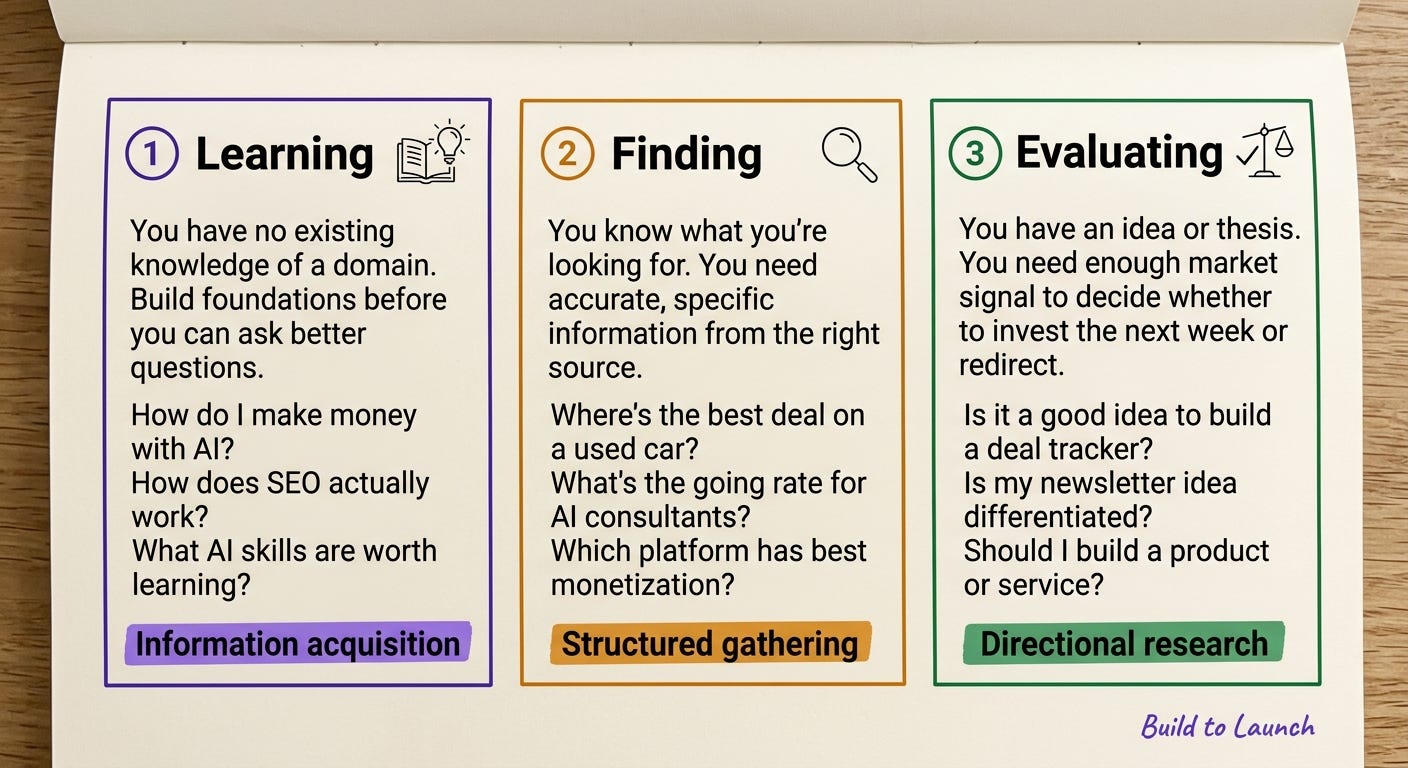
Type 1: Learning something new. You do not know enough yet to ask a sharp question. Example: you want to understand SEO, AI monetization, or how agents work before going deeper. The goal here is foundation.
Type 2: Data collection. You know what you need and now you need specific, current information. Prices. Listings. Rates. Providers. Tools. The goal here is not broad understanding. It is finding the right data fast.
Type 3: Idea validation. You have a thesis and want enough signal to decide whether to keep going. You are not looking for perfect proof. You are looking for enough evidence to invest the next week or redirect.
These question types can blur together. A question that feels like learning may actually be a decision question, and something that sounds complex may just need a straightforward lookup. Once you name the question type, the rest gets easier.
The 5-Stage Research Process
The framework itself is simple. It is not tied to one tool. It is just a way to stop treating every research question the same.
If you want to see how this process shows up in different kinds of work, here are three examples:
Researching visual product covers without a design background
Researching what was actually true about Substack Notes performance
Researching whether an app idea was worth building before writing code
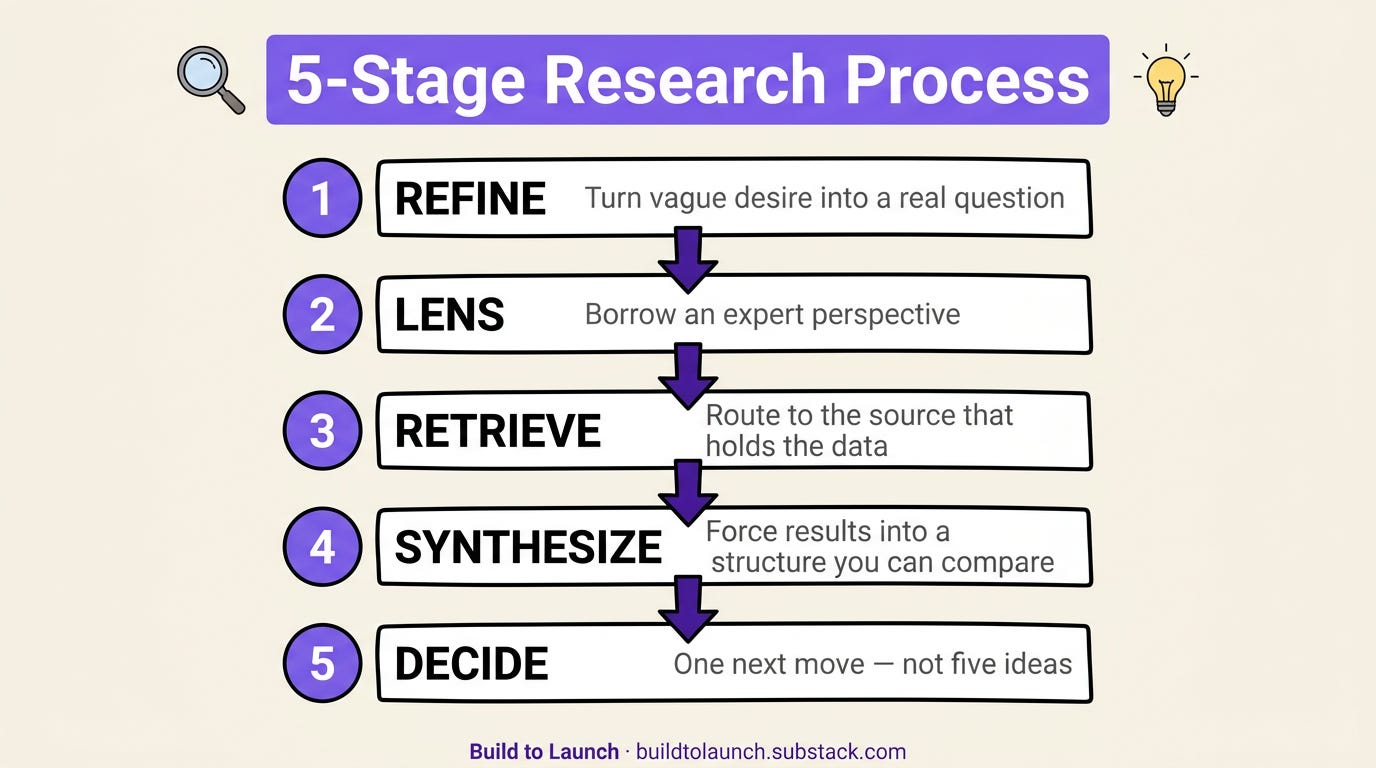
Stage 1: Refine. Turn the vague desire into a real question.
Stage 2: Lens. Decide whose perspective you are borrowing.
Stage 3: Retrieve. Go to the source that actually holds the data.
Stage 4: Synthesize. Force the results into a structure you can compare.
Stage 5: Decide. End with one next move, not five ideas.
That was the framework. Next, I ran all three question types live so you can see how the same process produces completely different outputs depending on the question.
In the live demo, I also use reusable research skills like idea-research and data-curator inside the Build to Launch MCP so I am not rebuilding the same research process from scratch each time.