
Research with Claude Code: Validate Your App Idea in 70 Minutes
A case study where I researched 16 sites in 70 minutes and found 7 goldmines. Here's the exact AI research stack, the 9 prompts I used, and a framework you can copy for any niche.

Building for weeks only to discover the idea already exists, or the data is locked down, is the nightmare. But validation feels too hard to prioritize: time-consuming, unclear what to check, easy to skip. I didn’t skip it. This is a Claude Code case study: I validated a deal aggregator in 70 minutes before building anything. This guide walks through the full validation process: 16 sites researched, 7 goldmines found, 6 blocked sources avoided, the traps I sidestepped, the AI stack (Perplexity + Notion + Claude Code), 9 copy-paste prompts for parallel agents, and the framework you can use to validate any idea.

Before you build anything, a tool, a product, an aggregator… you need to answer: Is there accessible data? What’s the competition doing? Which sources are open, which are locked down? Is this even worth building?
Most people spend weeks clicking through sites, taking notes, guessing. Or worse, skip validation entirely and build blind.
I compressed this into 70 minutes using AI. I’ve done this kind of research before with Cursor, and the methodology works for any industry. Deal sites, API marketplaces, job boards, newsletter platforms, SaaS directories, any ecosystem where you need to map the landscape fast.
Here’s the exact process, applied to deal-finding sites: 16 sites researched, 7 goldmines found, 6 blocked sources avoided, 1 working app shipped. Same 70-minute framework. Same AI research stack. Replicable for any niche.
If you’re new to Claude Code, start with the beginner’s guide. Once you’ve validated your idea with this process, here are 15+ projects you can build.
What you’ll go through with me:
What I Found: The Deal Site Landscape in 70 Minutes — research results from 16 sites, 7 goldmines vs 6 blocked sources
What This Taught Me (And Why It Applies Everywhere) — universal insights about RSS, WordPress APIs, and data accessibility
This Works for Any Ecosystem — apply the same process to SaaS, jobs, newsletters, APIs, research tools
How I Researched Deal Sites in Minutes — the AI research stack and 9 copy-paste prompts for parallel agents
Building the App: Key Decisions and Challenges — deduplication, translation, timezones, and what almost broke
Apply This to Your Next Project — the framework, data access hierarchy, and 30-minute action plan
Next Steps — beginner, intermediate, and advanced starting points
🎁 The 9 Claude Code research prompts, complete research kit (Notion template + Perplexity prompts + full results), and framework for validating any idea, all included.
Hi, I’m Jenny 👋
I build AI systems and tools, then share how I did it. I run the Practical AI Builder program — for people who already use AI and want to build real things with it. Check it out if that sounds like you.
If you’re new to Build to Launch, welcome! Here’s what you might enjoy:

What I Found: The Deal Site Landscape in 70 Minutes
After relocating cross-country, I needed a deal aggregator that didn’t exist. Before building it, I had to know: Which sites have accessible data? Which are blocked? What are the business models?
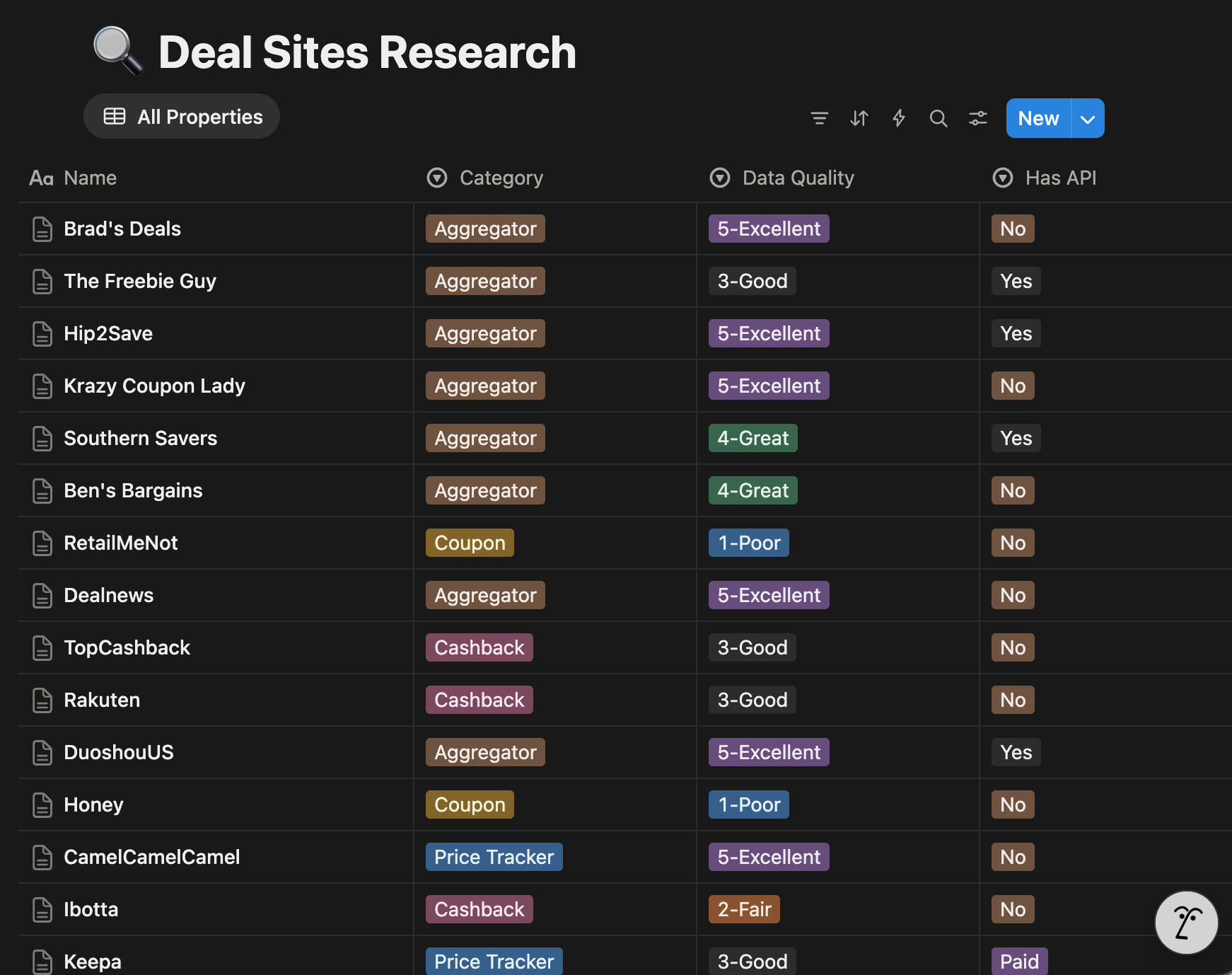
Using Perplexity, Notion, and Claude Code in parallel, I mapped 16 sites and found 7 with working RSS feeds or APIs.
Notion database with research results
The Four Categories of Deal Sites
The deal-finding world breaks down into four distinct categories, each with different business models and (critically for builders) different levels of data accessibility.
1. Deal Aggregators
They are the sites that actually curate deals.
Slickdeals, Hip2Save, Ben’s Bargains, Dealnews, Southern Savers, Duoshou, and Dealmoon. Some are community-driven (Slickdeals), others are editorial (Ben’s Bargains proudly claims “100% human-sourced”). Duoshou and Dealmoon target Chinese-speaking shoppers in the US with deals from American retailers.
The surprise?
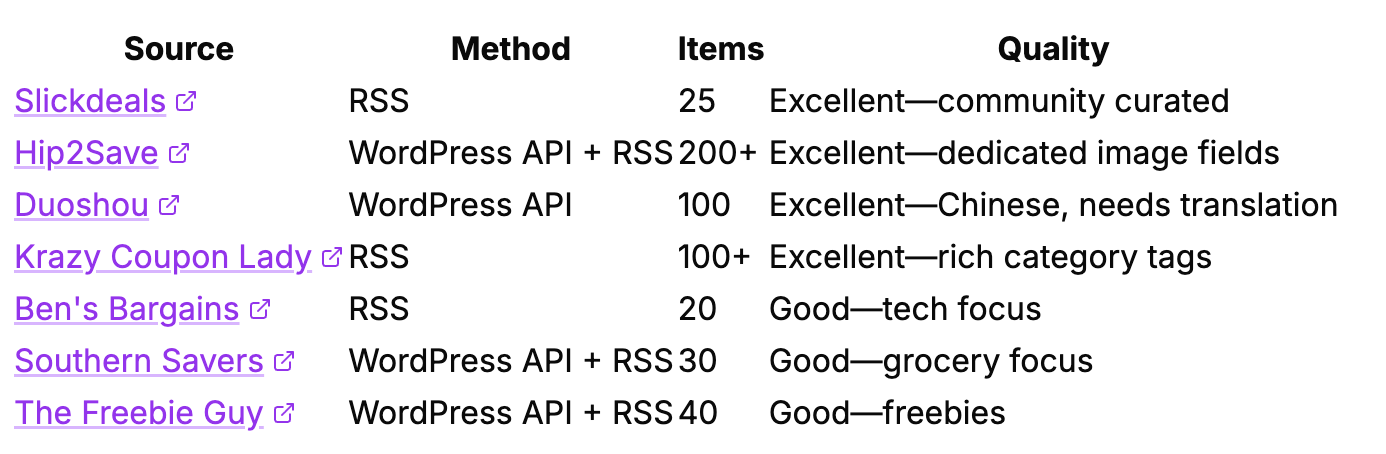
Most of these run on WordPress and expose their content through RSS feeds or REST APIs. Hip2Save’s WordPress API returns structured JSON with titles, prices, images, and categories. Slickdeals has an RSS feed with 25 curated deals, including their famous “thumb score” ratings.
This was the goldmine I was looking for.
2. Cashback Platforms
Rakuten, TopCashback, and Ibotta negotiate commission splits with retailers—getting 5-15% on purchases—and share a portion with users. For builders, these are essentially closed ecosystems. No public APIs, no RSS feeds.
They guard their retailer relationships carefully.
3. Coupon Extensions
Sites like Honey (owned by PayPal) and RetailMeNot auto-apply coupon codes at checkout. These sites are increasingly hostile to scrapers. RetailMeNot has extensive anti-bot measures. Honey is facing class-action lawsuits over affiliate commission attribution—allegedly replacing creators’ tracking tags with its own.
The browser extension model seems to be hitting some turbulence.
4. Price Trackers
Such as CamelCamelCamel and Keepa focus specifically on Amazon price history. CamelCamelCamel is free but now has Cloudflare protection on its RSS feeds. Keepa has a paid API starting at €19/month.
These are complementary to deal aggregators, not competitors—they track prices over time; aggregators find current deals.
What Actually Works (And What’s Blocked)
Here’s the practical breakdown for anyone thinking about building in this space:
Working Sources (7 RSS feeds + 5 WordPress APIs)
Blocked or Inaccessible (6 sites)
RetailMeNot: Extensive anti-bot measures, legal warnings in robots.txt
Honey: No public data access, anti-bot measures
Brad’s Deals: No feeds, extensive blocking rules
Dealnews: RSS endpoint returns JavaScript instead of XML
CamelCamelCamel: RSS feeds protected by Cloudflare
Dealmoon: Explicitly blocks AI crawlers in robots.txt, no public API
The takeaway: Plenty of high-quality sources are open and accessible. You don’t need to scrape protected sites. The deal blogs want you to access their data, it drives affiliate revenue for them.
What This Taught Me (And Why It Applies Everywhere)
After researching 16 sites and building this app, a few things stood out:
RSS feeds still work. I expected to need complex scraping, browser automation, maybe even proxy rotation. Nope. Good old RSS feeds, a technology from 1999, power most of my data collection. The deal world hasn’t moved on because RSS works perfectly fine. And this isn’t just for deals, blogs, podcasts, job boards, government data, RSS is the universal data access layer nobody talks about. MCP servers make connecting to these feeds even simpler.
WordPress APIs are everywhere. Deal blogs love WordPress. And WordPress exposes a REST API by default. This is why Hip2Save, Southern Savers, and The Freebie Guy are all trivially easy to access, they’re running the same CMS with the same API structure. 43% of the web runs WordPress. If your target sites run WP, you have instant API access. This applies to: deal blogs, recipe sites, news outlets, local business directories.
The Honey scandal is a warning. PayPal paid $4 billion for Honey in 2020. By 2024, they’re facing class-action lawsuits over how the extension handles affiliate commission attribution. The browser extension model, inserting yourself between shoppers and checkout, creates complex incentive problems.
Human curation still matters. Ben’s Bargains proudly advertises “100% human-sourced.” Slickdeals has a community voting system that surfaces the best deals. Even in an age of AI, human judgment remains valuable. Deciding “Is this actually a good deal?” is something algorithms still struggle with.
Anti-bot measures are increasing. Sites like RetailMeNot have extensive blocking rules. But here’s the thing, plenty of other sites are wide open. You don’t need to fight the locked ones. Find the open ones. True across every industry.
The research was validation, not just preparation. If I’d found exactly what I needed, I wouldn’t have to build. If data access was locked down, it wouldn’t be worth the effort. Instead: 7 open sources, nearly no English-language solution, clear gap. Even if only my family uses it, saving myself time every week is worth it. I use this same AI research workflow across different domains, and here’s how I studied 3,000 Substack notes with the same framework to understand what content actually works.
This Works for Any Ecosystem
The same 70-minute process applies to:
SaaS directories — Which review sites have APIs? Which block scrapers? How do they categorize tools?
Job boards — Where do tech jobs actually get posted? Which have RSS? What’s the posting frequency?
Newsletter platforms — Which Substack competitors exist? What’s their data access? What features differentiate them?
API marketplaces — RapidAPI vs alternatives? Which have accessible catalogs? What’s the pricing model?
Content platforms — Medium, Dev.to, Hashnode—which allow crossposting? What’s the canonical link policy?
Market research — Who are the competitors? What’s their tech stack? What public data can I access?
Research tools — Which academic databases have APIs? What’s behind paywalls? Where can I scrape ethically?
E-commerce platforms — Shopify, WooCommerce, BigCommerce—what data can third-party apps access?
The questions change. The research methodology stays identical: map the landscape → test accessibility → understand business models → validate data quality.
Whether you’re researching deal sites, API marketplaces, or newsletter platforms—the pattern repeats across any domain. Once validated, pick a project and build it.
Keep reading with a paid subscription
The research results and insights are yours. Here’s what’s next:
The exact 9 Claude Code prompts I used — Copy-paste ready prompts for parallel agent deployment
The AI research stack setup — How Perplexity, Notion, and Claude Code work together
Your 30-minute action plan — Apply this to validate any niche yourself
Complete research kit — Notion template, 15+ Perplexity prompts, full technical results
The research framework itself and the practical implementation is in How to Do Research With AI Effectively.
How I Researched Deal Sites in Minutes
Here’s exactly how I did it, three AI tools, each for what it does best: